Key Takeaways
• A complete edible oil refinery has five core sections: degumming/neutralizing, bleaching, dewaxing (for waxy oils), deodorizing and filtration, supported by boiler, thermic fluid heater, vacuum and effluent systems.
• Capacity is planned in tonnes per day (TPD). Smaller units often run batch or semi-continuous; plants of 100 TPD and above are normally built as fully continuous lines.
• Total investment depends on capacity, physical or chemical refining, feed oils, automation level and effluent treatment, so it is best fixed through a detailed, scope-based quotation rather than a generic figure.
India is one of the world’s largest consumers of edible oil, and a large share of that demand is met through imported crude oils that must be refined locally before they reach the kitchen. That structural gap is why an oil refinery plant setup in India remains one of the most reliable ventures in the agro-processing sector.
But success starts with the right plant: the right machinery, the right capacity and a realistic investment plan. This guide walks you through each of them, including edible oil refinery plant machinery, capacity planning and investment considerations, and shows how a turnkey edible oil refinery project partner such as Pemac Projects can take you from feasibility study to commissioning.
Why set up an edible oil refinery plant in India?
Crude vegetable oils such as palm, soybean, sunflower, rice bran and cottonseed are not fit for direct consumption. They contain gums, free fatty acids, pigments, waxes and odour compounds. A refinery removes these impurities and delivers clear, stable, neutral-tasting cooking oil that meets food-safety standards.
Government programmes that encourage domestic oil palm cultivation and oilseed processing, together with steady growth in packaged and branded oils, continue to support refinery demand. Refiners can also add value through by-products such as soapstock, acid oil, lecithin and fatty acid distillate.
Core machinery in an oil refinery plant
A modern continuous edible oil refinery plant is a chain of tightly integrated process sections. The table below summarises the key oil refinery plant machinery, what each section does and the equipment involved.
| Section | Key equipment | What it achieves |
| Degumming / neutralizing | Acid dosing, mixers, retention vessels, centrifugal separators, soap-stock handling | Removes phospholipids (gums) and free fatty acids |
| Bleaching | Vacuum bleacher, earth dosing system, pressure leaf filters, polish filters | Removes colour, trace metals, oxidation products and residual soap |
| Dewaxing / winterizing | Crystallizers, chilling system, filters | Removes waxes so oil stays clear at low temperature (sunflower, rice bran, cottonseed) |
| Deodorizing | Deaerator, heat exchangers, deodorizer column, scrubber, vacuum system | Strips odour, residual FFA and volatile compounds |
| Utilities | Steam boiler, thermic fluid heater, cooling tower, compressed air, DG set | Supplies heat, vacuum and power |
| Effluent treatment | ETP / ZLD system | Treats process wastewater to meet pollution-board norms |
Choosing the right refinery capacity
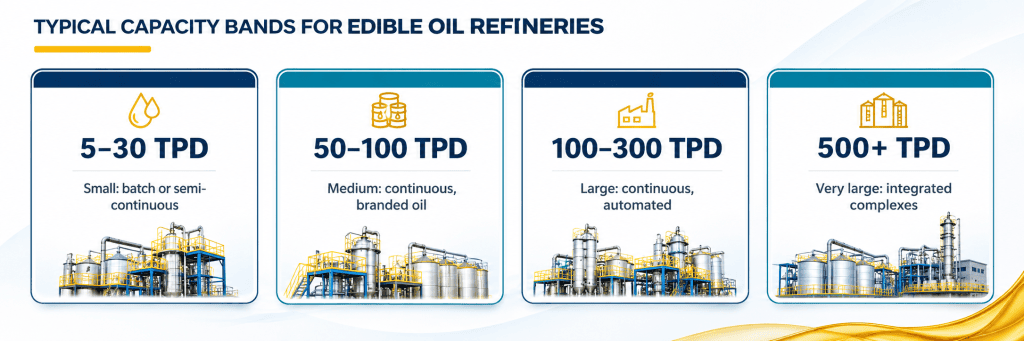
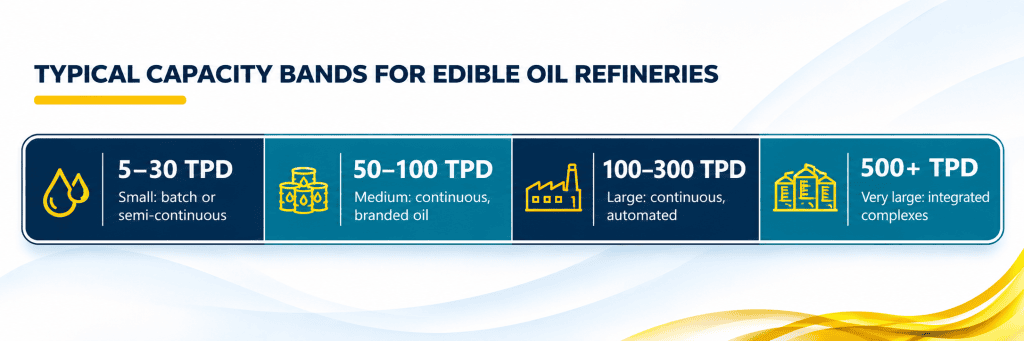
Capacity is expressed in tonnes per day (TPD) of crude oil processed. Choose it by looking at your raw-material availability, the market you intend to serve and your expansion plans, not just current demand.
• Small units (roughly 5 to 30 TPD): suited to regional brands, job-work refining and pilot operations; batch or semi-continuous.
• Medium units (roughly 50 to 100 TPD): the most common entry point for branded oil producers; continuous operation gives better yield and consistency.
• Large units (100 TPD to 500 TPD and above): built for bulk packers, traders and integrated oil mills; fully continuous, highly automated, with heat recovery.
What decides your investment?
There is no single price for a refinery. Quoting a flat number without understanding scope is a common cause of budget overruns. These are the main cost drivers you should define up front:
• Capacity and mode of operation (batch, semi-continuous or continuous).
• Refining route: physical refining or chemical refining, or a flexible combination.
• Feed oils: palm, soybean, sunflower, rice bran, cottonseed or multiple oils.
• Automation level (manual, PLC or full SCADA) and instrumentation.
• Utilities such as boiler, thermic fluid heater, cooling tower and power backup.
• Effluent treatment and zero liquid discharge requirements.
• Civil work, land, storage tanks and building design.
• Optional add-ons: dewaxing, fractionation, lecithin recovery, packing and filtration upgrades.
Because every project differs, a good turnkey edible oil refinery plant manufacturer will prepare a scope-based quotation after understanding your feedstock, capacity target and site conditions. For an accurate edible oil refinery plant cost estimate, the project scope, utilities and site requirements must be assessed together.
Approvals and licences to plan for
Start the paperwork early, because several approvals run in parallel with plant fabrication:
• Business and MSME (Udyam) registration, GST registration.
• FSSAI licence for edible oil manufacturing.
• Consent to Establish and Consent to Operate from the State Pollution Control Board.
• Factory licence, fire safety clearance and boiler inspection approval.
• Power connection and water source permissions.
Step-by-step roadmap: from idea to production
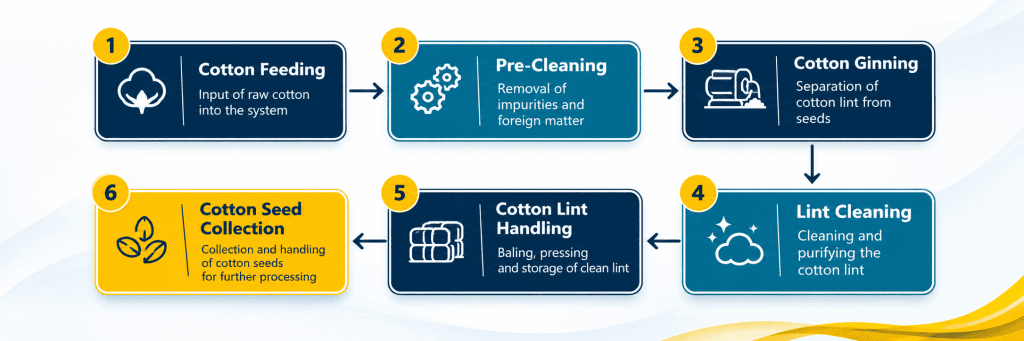
A structured roadmap keeps the project on schedule and on budget:
How Pemac Projects provides solutions
Pemac Projects is a manufacturer of edible oil refinery plants, solvent extraction plants and oleochemical solutions, delivering turnkey projects from plant design and engineering to installation and commissioning. For refinery investors, this means a single point of responsibility for the entire edible oil processing plant project.
What Pemac delivers for this application
• Continuous degumming and neutralizing sections with acid, water or enzymatic degumming options.
• Continuous bleaching, dewaxing / winterizing, physical deodorizing and dry fractionation.
• Filtration equipment including horizontal and vertical pressure leaf filters and micro polish filters.
• Effluent treatment (ZLD), acid oil, lecithin and spent earth recovery to improve overall plant economics.
Pemac Projects at a glance
Based in Rabale, Navi Mumbai, Pemac Projects Pvt. Ltd. manufactures oil mill, seed preparation, solvent extraction, edible oil refinery, oleochemical, biodiesel, ethanol, feed and filtration plants, and delivers end-to-end turnkey plant engineering solutions for customers in India, Africa, Asia and beyond.
Explore related Pemac solutions
• Edible oil refining plants Edible oil refining plants
• Continuous degumming & neutralizing Continuous degumming & neutralizing
• Continuous bleaching section Continuous bleaching section
• Continuous physical deodorizing Continuous physical deodorizing
• Filtration equipment Filtration equipment
• Effluent water treatment plant & ZLD Effluent water treatment plant & ZLD
Frequently asked questions
What is the minimum capacity for an edible oil refinery in India?
Small refineries can start at around 5 to 10 TPD in batch mode, but most commercial brand owners prefer continuous plants of 50 TPD and above for better yield and consistency.
Should I choose physical or chemical refining?
Physical refining suits high-FFA, low-gum oils such as palm and rice bran, while chemical refining remains common for oils such as cottonseed, sunflower or soybean oils. A flexible design can support both.
Can one refinery process different oils?
Yes. A well-designed plant can refine several oils, provided the sections are sized and configured for the widest feedstock range you plan to handle.
Does Pemac Projects supply turnkey refinery plants?
Yes. Pemac provides end-to-end turnkey solutions covering design, fabrication, installation and commissioning of edible oil refinery plants.
Conclusion
Whether you are planning an edible oil refinery plant setup in India or upgrading an existing facility, the right technology partner makes the difference between a plant that merely runs and one that performs. Compare the process design, oil refinery plant installation and commissioning support, and long-term service capability before selecting a supplier. With more than 15 years of experience, 100+ project installations and customers in over 20 countries, Pemac Projects combines process know-how with in-house manufacturing to deliver plants that are efficient, safe and built around your feedstock and business goals.
Planning an oil processing project? Talk to Pemac Projects. Get a scope-based quotation for your capacity, feedstock and budget.
Leave A Comment