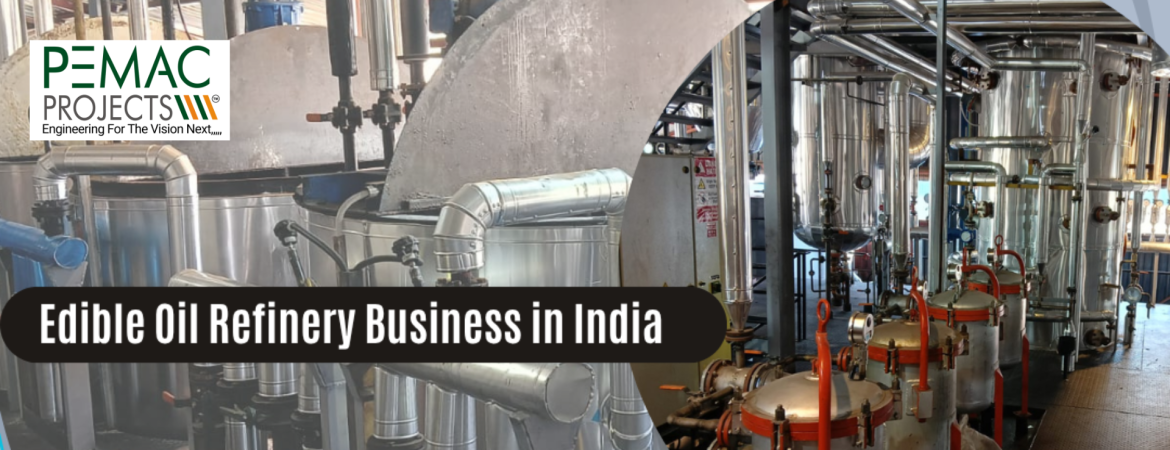
India’s edible oil sector continues to expand as demand for refined cooking oils grows across urban and rural markets. Whether you’re looking to process rice bran, sunflower, soybean, or palm oil, a structured plan — from plant selection to commissioning — is essential.
Pemac Projects offers turnkey design and engineering solutions tailored to small-to-large edible oil refinery projects across India and overseas.
1. Choose the right refinery model and capacity
Refinery choice depends on feedstock and market target:
Batch refineries (small to medium) — best for 5–25 TPD capacities and diversified oils.
Continuous refineries (medium to large) — suited for 30 TPD and above, ideal for single-feed high-volume operations.
Integrated plants — combine crushing/expeller, solvent extraction (for low-oil seeds like rice bran/soybean), and refining for complete value capture.
Pemac Projects offers both physical and chemical refining solutions and turnkey integration from oil expellers to deodorization.
Tip: If you plan rice bran oil, consider adding a solvent extraction plant or partnering with solvent specialists to recover maximum oil. Pemac Projects has project experience in rice bran and solvent-based refining routes.
2. Core equipment checklist
Key process units you’ll need (typical order of operations):
Seed/Cake preparation (cleaning, dehulling, flaking) — for crushing or solvent extraction lines.
Oil extraction — mechanical expellers (oil expeller plant) and/or solvent extraction plant.
Degumming & Neutralization — enzymatic degumming is an option for some oils (improves oil quality and reduces bleaching load).
Bleaching — removes pigments and trace metals.
Dewaxing / Winterization — for oils with wax content (e.g., rice bran winterization).
Deodorization — final stripping of volatiles and odour, producing neutral edible oil.
Utilities — steam boiler, vacuum system, cooling water, effluent treatment, and solvent recovery.
Efficient edible oil refinery equipment and plant layouts should be designed to minimise utilities and maximise oil recovery. Compare designs on heat integration, solvent recovery efficiency, and automation before investment.
3. Approvals, licensing & compliance
You’ll typically need:
- 1. Company incorporation and GST registration.
2. Factory licence / local municipal trade licence.
3. Pollution control approvals (SPCB consent to establish/operate) and ETP/effluent compliance.
4. Food safety compliance if packing under your brand (FSSAI registration/licence).
Local state requirements vary — plan for site surveys and SPCB clearances early.
4. CAPEX, OPEX and economics
CAPEX depends on capacity, automation, and whether you integrate solvent extraction. Small batch refineries have lower startup costs; continuous large refineries benefit from scale but need higher investment.
OPEX drivers: feedstock cost, steam, electricity, chemicals (bleaching earth, alkali), and logistics.
Break-even and ROI depend heavily on sourcing (own crushing or purchased crude), product mix (refined oil, deodorized oil, acid oil, soap stock), and market access.
India’s edible oil demand and consumption growth make refinery investment attractive for new entrepreneurs.
5. Quality control and testing
Set up an in-house quality control lab or partner with external labs for:
a) FFA, peroxide value, moisture & volatile content, colour, iodine value, and sensory checks.
b) Routine tests at each stage (incoming crude, post-bleaching, final refined edible oil).
Strong QC systems ensure compliance with FSSAI and industry standards.
6. Why choose Pemac Projects as your turnkey supplier
Pemac Projects provides end-to-end engineering — from oil expeller machines and solvent extraction plants to physical and chemical refining systems — with expertise across Indian and global markets.
By choosing Pemac Projects, you gain a reliable partner for design, manufacturing, installation, and commissioning of complete edible oil refinery plants and edible oil processing plants.
7. Operational best practices
1. Start small, scale modularly. Begin with a capacity that matches procurement and offtake certainty.
2. Train operators on degumming, bleaching, and deodorization steps — these determine final product quality.
3. Maintain solvent recovery and safety standards when using hexane extraction.
4. Plan logistics for crude oil sourcing, packaging, and distribution.
8. Marketing & distribution
a) Packaged consumer edible oils require branding, quality certification, and distributor partnerships.
b) Bulk refined oil supply for industrial buyers depends on long-term contracts and consistent product quality.
c) Explore B2B supply opportunities with vanaspati manufacturers, food processors, and institutional buyers.
If you have any queries or need more information about Edible oil refinery plants, solvent extraction plants or oil expeller plants feel free to contact us.
Leave A Comment